

DnD Character Creation
DnD Character creation is where your great adventure begins. Your character combines game statistics, story and imagination to become your hero in the D&D multiverse. You’ll choose a class (like Barbarian or Wizard), a species (such as Orc or Halfling) and a background (like Criminal or Sage) to define your abilities and history. You’ll also assign ability scores, choose an alignment and fill in the final details such as personality, appearance and languages.
Below you can explore all the Dungeons & Dragons 2024 classes, backgrounds and species including all their features and traits.
After that, we’ll dive deeper into how to make a Dungeons and Dragons character from start to finish.
We are currently working on the Feats, Magic Items and Spell pages. Please keep an eye out for updates!
Creating Your DnD Character
1. Choosing a Class
With 2024 DnD character creation, the very first decision you’ll makes is selecting a class. This step sets the foundation for your character’s role, abilities and progression through the campaign. Under the revised system, the sequence is clear: choose your class before determining your species, background or ability scores. To keep track of everything it’s important to have a character sheet at hand.
Things to consider
Talk with your DM. What kind of campaign do they plan to run? Whether it’s exploring ancient ruins or navigating city intrigue, shape your adventurer to fit that world.
- Consider your preferred role in the party. Think about whether your group needs a front-line tank, a high-damage spellcaster, a support character or a skill-focused specialist.
Review the hallmark features of each class.
Hit Dice and Durability: Classes like Fighters and Barbarians can take more hits, while Sorcerers and Wizards rely on staying out of direct combat.
Primary Ability Scores: Each class relies on specific abilities for its main powers. For example, Wizards use Intelligence, Paladins use Strength and Charisma and Rogues use Dexterity.
Special Resources or Mechanics: Some classes feature unique systems, such as Sorcery Points for Sorcerers or Focus Points (Ki Points in 5e) for Monks.
Think about long-term progression. Each class gains powerful features at specific levels. When choosing, consider how the class develops over time and what kind of playstyle you’ll enjoy most.
Prepare for ability scores. Once your class is chosen, note which ability scores are most important for it. This will help you make informed decisions in the next step when assigning ability scores and selecting your origin.
| Class Role Example | Key Trait |
|---|---|
| Front-line / Defender (Fighter, Paladin) | High hit points and strong armor proficiency |
| Spellcaster / Controller (Wizard, Sorcerer) | Wide spell access, low physical durability |
| Skill or Utility Specialist (Rogue, Bard) | Versatile in exploration, skills, and social encounters |
| Hybrid or Adaptive (Ranger, Monk) | Balanced blend of combat and mobility or utility |

2. Determining Your Origin (Species and Background)
After you have selected your class, the next step in creating your character is to determine your origin. Your origin is the combination of your species (the being you are) and your background (the life you lived before adventure). Together they define your character’s heritage, traits, proficiencies and your starting mechanical benefits.
2.1 Species
Your species represents your character’s physical form and lineage. It determines features such as size, speed, special resistances, innate abilities and traits unique to that species. In the 2024 rules the term “species” replaces “race”.
Each species gives:
A fixed set of traits for movement, size and special features.
Languages, tool or weapon proficiencies and sometimes innate spells or other features depending on the species.
2.2 Backgrounds
Your background reflects your character’s prior life, training and personal history. Under the 2024 rules, your background grants:
A choice of ability-score increases: you pick from a list tied to the background. You may either assign +2 to one ability and +1 to another, or assign +1 to three different abilities.
Two skill proficiencies.
One tool proficiency (or similar trait tied to your background).
A specific “Origin Feat” associated with your background.
Starting equipment appropriate to your prior life.
Combining Species and Background
The species gives your baseline traits and flavour and the background gives your mechanical starting bonuses and story foundation. Because ability-score increases come via the background, you are free to combine any species with any background and build the character that suits your concept. For example:
A dwarf (species) with the Soldier background could become a resilient front-line warrior with skill proficiencies in Athletics and Intimidation.
An elf (species) with the Sage background could become a learned scholar who wields magic and uses intelligence and wisdom proficiencies.
3. Ability Scores
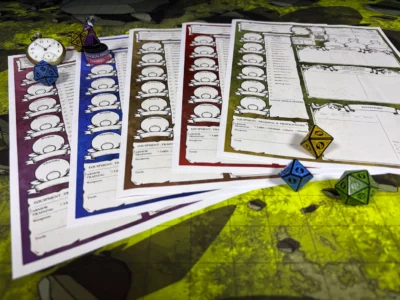
Once you have chosen your class, species and background, the next step in creating your character are ability scores. Every character has six abilities(scores) that measure different aspects of power and skill. These six scores shape every part of your character, how well they fight, think, survive, influence others etc.
| Ability | What It Represents |
|---|---|
| Strength (STR) | Physical power, athletics and carrying capacity. |
| Dexterity (DEX) | Agility, balance, reflexes and accuracy with ranged weapons. |
| Constitution (CON) | Endurance, health and resistance to physical strain. |
| Intelligence (INT) | Memory, reasoning and knowledge. |
| Wisdom (WIS) | Awareness, intuition and perception. |
| Charisma (CHA) | Presence, confidence and force of personality. |
3.1 Generating Ability Scores
In the 2024 rules, players can generate ability scores using one of three official methods. Your Dungeon Master may choose which to use for the campaign.
- Assign the following scores to your abilities in any order:
15, 14, 13, 12, 10, 8
- Roll four six-sided dice (4d6).
- Add up the highest three dice and record the total.
- Repeat steps 1 and 2 five more times, so that you end up with six numbers in total.
- All abilities start at 8.
You have 27 points to distribute.
The highest score you can set this way is 15 before modifiers.
- Raising a score costs more points the higher it goes:
| Score | Cost |
|---|---|
| 8 | 0 |
| 9 | 1 |
| 10 | 2 |
| 11 | 3 |
| 12 | 4 |
| 13 | 5 |
| 14 | 7 |
| 15 | 9 |
Tips for Distributing Scores
Place your highest score in your class’s main ability.
(For example, Strength for Fighters, Intelligence for Wizards, Charisma for Bards)Assign your second-highest score to a defensive ability like Constitution or Dexterity.
Balance your remaining points based on role-playing flavor or party needs.
Avoid spreading points too thin, focus on what your character is meant to excel at.
3.2 Applying Bonuses from Background
After determining your base ability scores, it’s time to apply your background’s ability score increases.
You can either:
Add +2 to one ability and +1 to another ability
Add +1 to three different abilities.
This flexibility lets you match your mechanical strengths to your class concept or personality.
3.3 Ability Modifiers
Each ability also has a modifier. The modifier is a small number you add to dice rolls that involve that specific ability(such as attacks or skill checks).
To determine your ability modifiers, use the modifier table or you can calculate it yourself by:
- subtracting 10 from your ability’s score and divide it by 2, rounding down
Take those six numbers and write them down on your character sheet in the modifier boxes.
| Ability Score | Modifier |
|---|---|
| 3 | −4 |
| 4–5 | −3 |
| 6–7 | −2 |
| 8–9 | −1 |
| 10–11 | +0 |
| 12–13 | +1 |
| 14–15 | +2 |
| 16–17 | +3 |
| 18–19 | +4 |
| 20 | +5 |
4. Choosing an Alignment
Alignment helps describe your character’s general moral and ethical outlook. It is not a rule that restricts what you can do in the game. Instead, it is a simple guide that can help you decide how your character behaves in the world.
Dungeons and Dragons assumes that most adventurers are not evil. If you want to play a character with an evil alignment, always check with your Dungeon Master first.
The Nine Alignments
Each alignment is made of two parts:
Morality: good, neutral, or evil
Attitude toward order: lawful, neutral, or chaotic
Together they describe the way you typically view society, rules and other people. These descriptions are broad guidelines and your character does not need to match every part perfectly.
Unaligned Creatures
Some creatures do not have the ability to make moral or ethical decisions. These creatures are considered unaligned.
For example: a shark is a dangerous predator, but it is not evil, it’s simply following instinct.
- Lawful Good
Characters who follow laws or traditions and do what they believe is right. They protect the innocent and fight injustice without hesitation. - Neutral Good
Characters who try to do the most good they can. They respect rules when it makes sense, but they do not feel bound by them. - Chaotic Good
Characters who do what their conscience tells them, regardless of laws or expectations. They value freedom and might break rules to help others.
- Lawful Neutral
Characters who live by rules, traditions, or personal codes. They value order and discipline and prefer to stay focused on their duties. - True Neutral
Characters who avoid taking strong stances on moral or ethical questions. They simply do what seems best in the moment. - Chaotic Neutral
Characters who follow their own impulses and value personal freedom above all else. They rely on their wits to navigate the world.
- Lawful Evil
Characters who take what they want through structured or organized methods. They follow rules only when those rules benefit them and maintain order for personal gain. - Neutral Evil
Characters who act purely for themselves. They do not care who they harm while pursuing their desires. - Chaotic Evil
Characters who act unpredictably and violently. They are often driven by hatred, cruelty, or a desire for destruction.
5. Filling In the Details
At this stage of dnd character creation, you know who your hero is and what they can do. Now it is time to complete the rest of your character sheet by adding the numbers, features and personal details that will define your character in play.
5.1 Record Your Class Features
Have a look at your class. Each class has a feature table that lists the abilities you gain at every level.
At level 1:
Write down all the features your class gives you.
Some features let you make a choice, such as selecting a fighting style or choosing cantrips. Read each feature carefully and make any required decisions before moving on.
This step ensures that the special rules for your class are written clearly on your sheet and ready to use in the game.
5.2 Fill In Your Numbers
Next, complete the mechanical parts of your character sheet. These numbers tell you what to add to rolls during the game:
Saving Throws
Your class grants proficiency in specific saving throws. For each saving throw you are proficient in:
Add your Proficiency Bonus to the relevant ability modifier.
Write the total on your sheet.
For saving throws you are not proficient in:
Your modifier is simply the ability modifier for that score.
Some players like to write down every saving throw modifier, even the ones they are not proficient in, to make the sheet easier to reference during play.
Skills
Your background and class determine which skills you are proficient in. For each skill you are proficient in:
Add your Proficiency Bonus to the skill’s ability modifier and write the total.
For skills you are not proficient in:
Write only the ability modifier.
Passive Perception
Sometimes the DM checks whether your character notices something without asking you to roll.
This uses Passive Perception, which represents your general awareness when you are not actively searching.
Use this formula:
Passive Perception = 10 + your Wisdom (Perception) modifier
Include all bonuses that apply to Perception checks.
Example:
A Wisdom score of 15 gives you a +2 modifier, and proficiency in Perception adds +2 more.
Your Passive Perception is 14.
Hit Points
Your class determines your Hit Point maximum at level 1.
Use the table below and add your Constitution modifier:
| Class | Hit Point Maximum at Level 1 |
|---|---|
| Barbarian | 12 + Constitution modifier |
| Fighter, Paladin, Ranger | 10 + Constitution modifier |
| Bard, Cleric, Druid, Monk, Rogue, Warlock | 8 + Constitution modifier |
| Sorcerer, Wizard | 6 + Constitution modifier |
Your character sheet should have space to track:
Current Hit Points
Temporary Hit Points
Death Saving Throws
Initiative
Your Initiative is your Dexterity modifier, written in the Initiative space on your sheet.
This number determines how early your character acts in combat.
Armor Class
If you are not wearing armor and not using a shield, your base Armor Class (AC) is:
10 + your Dexterity modifier
If your starting equipment includes armor or a shield:
Look up the correct AC values in the Equipment section of the Player Handbook.
Some classes have features that give you a different way to calculate AC; use that method if it applies.
Attacks
In the “Weapons and Damage Cantrips” section of your sheet, list your starting weapons.
Your attack bonus depends on the weapon type:
Melee weapon attack bonus = Strength modifier + Proficiency Bonus
Ranged weapon attack bonus = Dexterity modifier + Proficiency Bonus
Look up your weapon’s damage and properties in the Equipment chapter and write them down as well.
You add the same ability modifier you use for attack rolls to your weapon’s damage rolls.
Spellcasting
If your class has Spellcasting or Pact Magic, write down your spell information.
Use these formulas:
Spell save DC = 8 + your spellcasting ability modifier + Proficiency Bonus
Spell attack bonus = your spellcasting ability modifier + Proficiency Bonus
Your class tells you which ability score you use for spellcasting.
Also note:
How many spell slots you have
How many cantrips you know
How many spells you can prepare
Choose your cantrips and prepared spells and write them on your sheet along with your number of spell slots.
5.3 Character Name
Choose a name that fits your character’s origin, culture and personality.
Your character can have:
A traditional name
A nickname
A chosen name
A name with personal or spiritual meaning
Write it at the top of your character sheet.
5.4 Final Details
Now add any final details that make your hero feel complete. These are not required for play, but they help you understand your character more deeply.
Ask yourself questions such as:
What is your character’s gender?
Who or what do you care about the most?
Your deepest fear?
What motivates you on your adventures: knowledge, wealth, justice, power, enlightenment or something else?
These final touches help make your character feel real and give your Dungeon Master ideas to weave into the story.